Is Intuitive Art Spiritual? Imagination and Practice
originally published on The 22nd of September 2023
updated on The 10th of January 2026
English↓↓↓
Nederlands ↓↓
Français ↓
English↓↓↓
Is Intuitive Art Spiritual? Imagination and Practice
Introduction
I’ve often wondered whether intuitive art is a spiritual or a psychological phenomenon, or something else entirely. It’s a question I’ve returned to many times, and my answer has shifted over the years—not because my work changed, but because my relationship with its meaning deepened. I no longer feel the need to choose a single explanation.
What I see clearly now is that my creative practice moves between intuitive and visionary modes—and very often, both are present within the same artwork.
Intuitive art, for me, is not a style or a technique. It is a way of listening. I experience this listening as an openness to something larger than myself—a quiet receptivity to a divine presence and to what wants to come through.
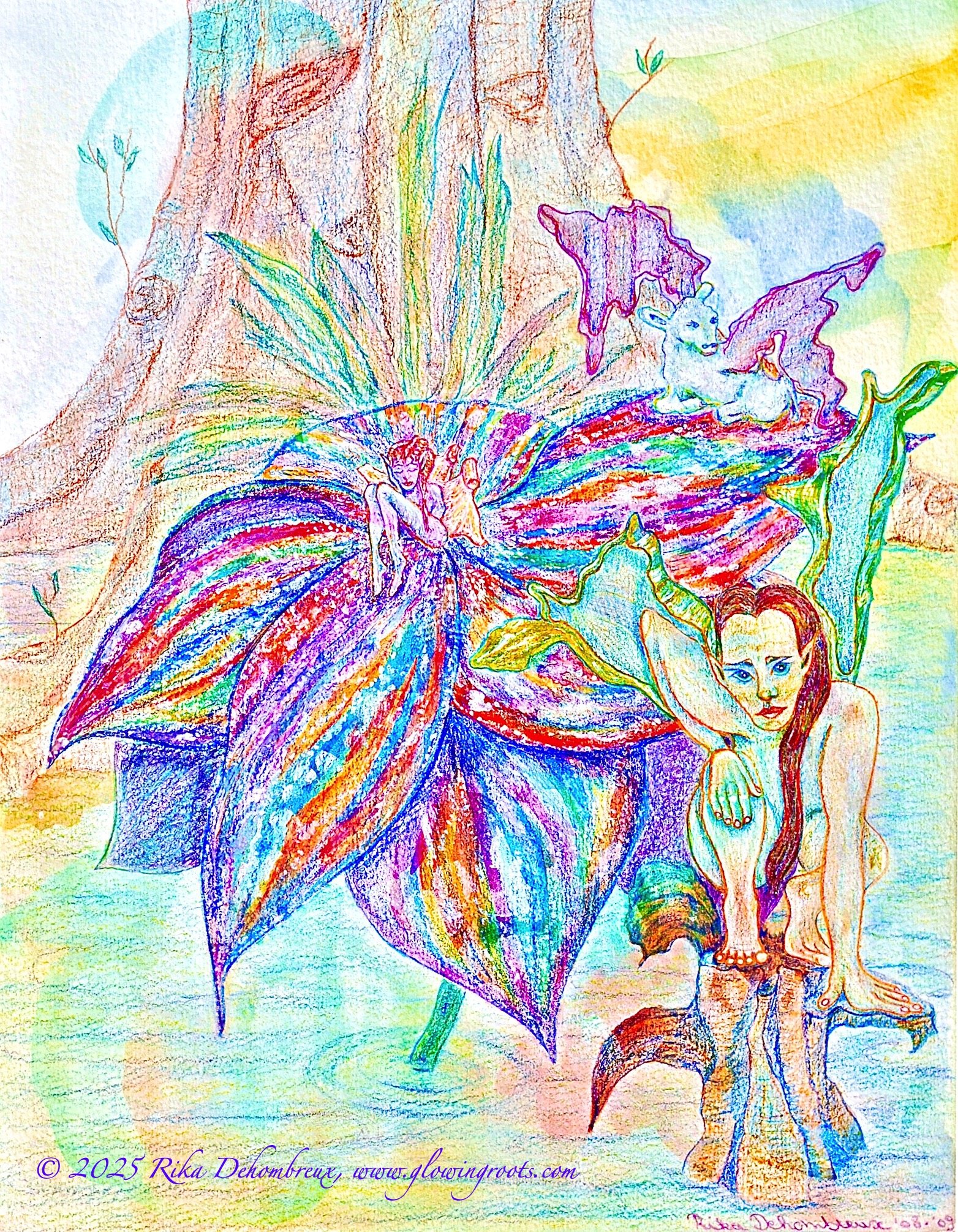
‘Guardian Fairy’, Intuitive Painting, Watercolors, Gouache and Pencils on Paper, by Rika Dehombreux, 2009
Imagination or Something More
For a long time, I spoke carefully about intuition. I would say that what appeared in my work could be imagination—images shaped by memory, experience, and the subconscious. That language helped me stay grounded and honest.
I was hesitant to name these appearances as divine messages. Today, that hesitation has softened. What once felt like imagination—or perhaps something divine—now feels like relationship: a quiet, ongoing dialogue with the universe, with presence itself.
The psychological element still plays a role. To shape what arrives as divine message, I draw on memory—formed through study, observation, and craft. Intuitive art, in my experience, needs both psychological grounding and spiritual openness.
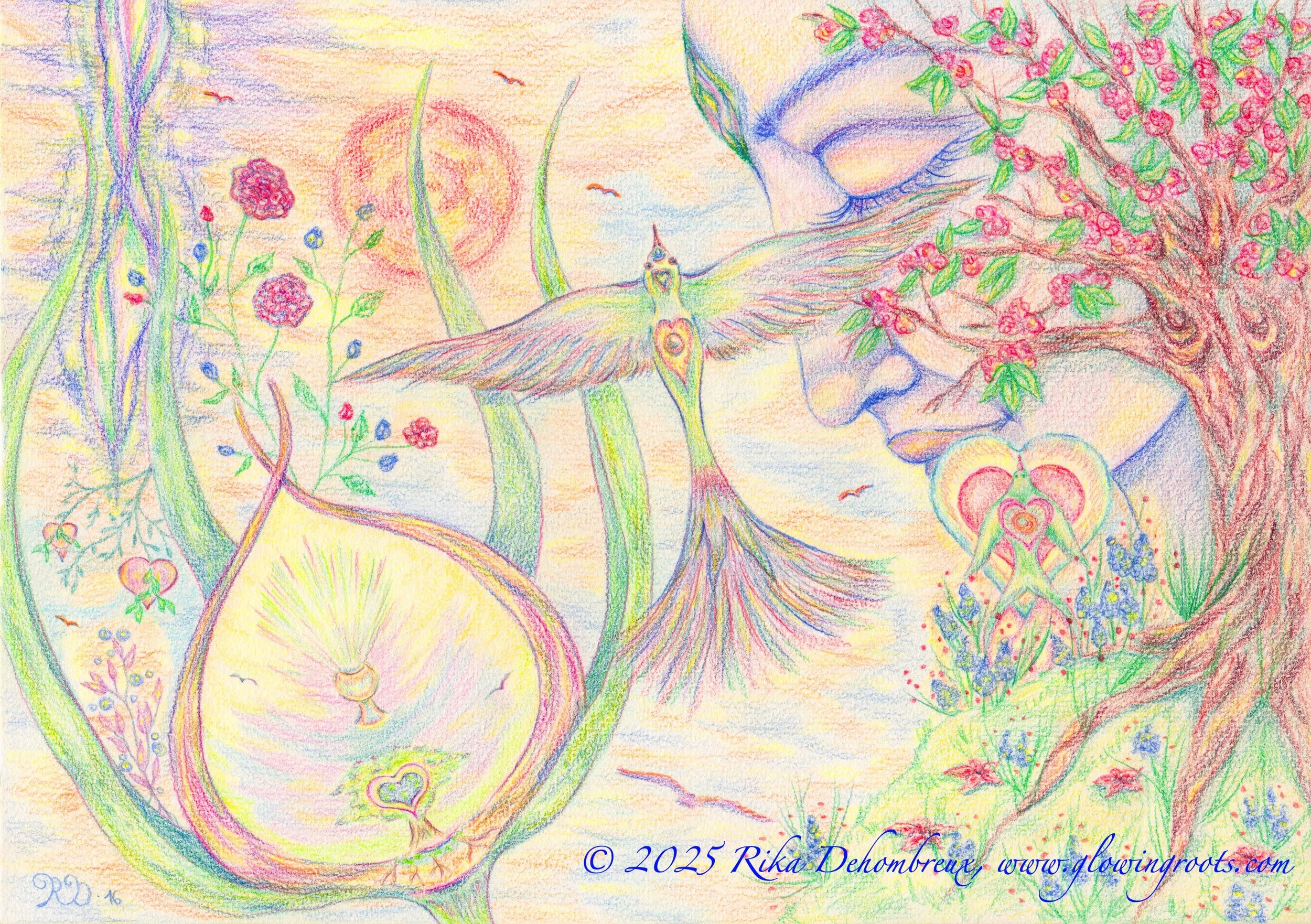
‘The Holy Grail’, Intuitive Drawing, Colored Pencils on Paper, by Rika Dehombreux, 2016
Intuitive Art: Listening Before Knowing
When I work intuitively, I begin by letting go of conscious planning. I quiet my mind and allow the image to emerge without directing it. In these moments, I rarely know what the artwork will become until it is nearly finished. The hand moves first; understanding follows later.
This intuitive painting process feels less like construction and more like arrival. I experience these works as discoveries rather than decisions—as if something unseen gently reveals itself through color, line, and form.
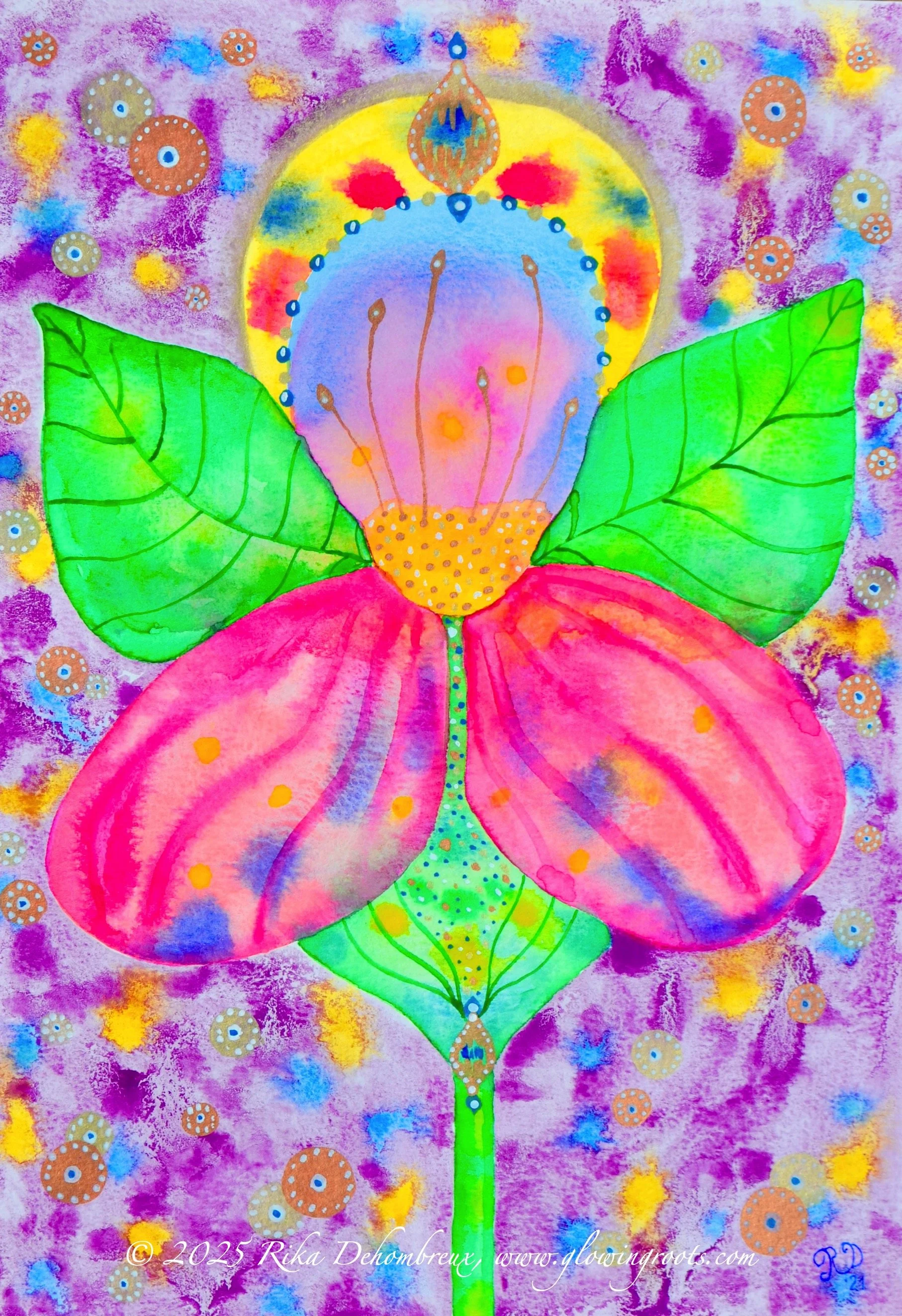
‘Empress of Flowers’, Intuitive Painting, Watercolors and Gouache on Paper, by Rika Dehombreux, 2021
Visionary Art: When Images Ask for Care
At other times, an image appears inwardly before I begin. It may arrive as a clear vision, a fragment, or a strong sense of presence. When this happens, the creative process asks for something different: attention, reference material, study, and deliberate artistic choices.
Some visions are difficult to shape entirely from imagination alone. They ask to be met with care, structure, and skill. This is where ongoing attention to craft becomes essential, expanding the inner library of images held in memory.
I don’t separate visionary art from intuitive art. Vision, for me, is intuition asking to be met halfway—through attention, study, and devotion to form.
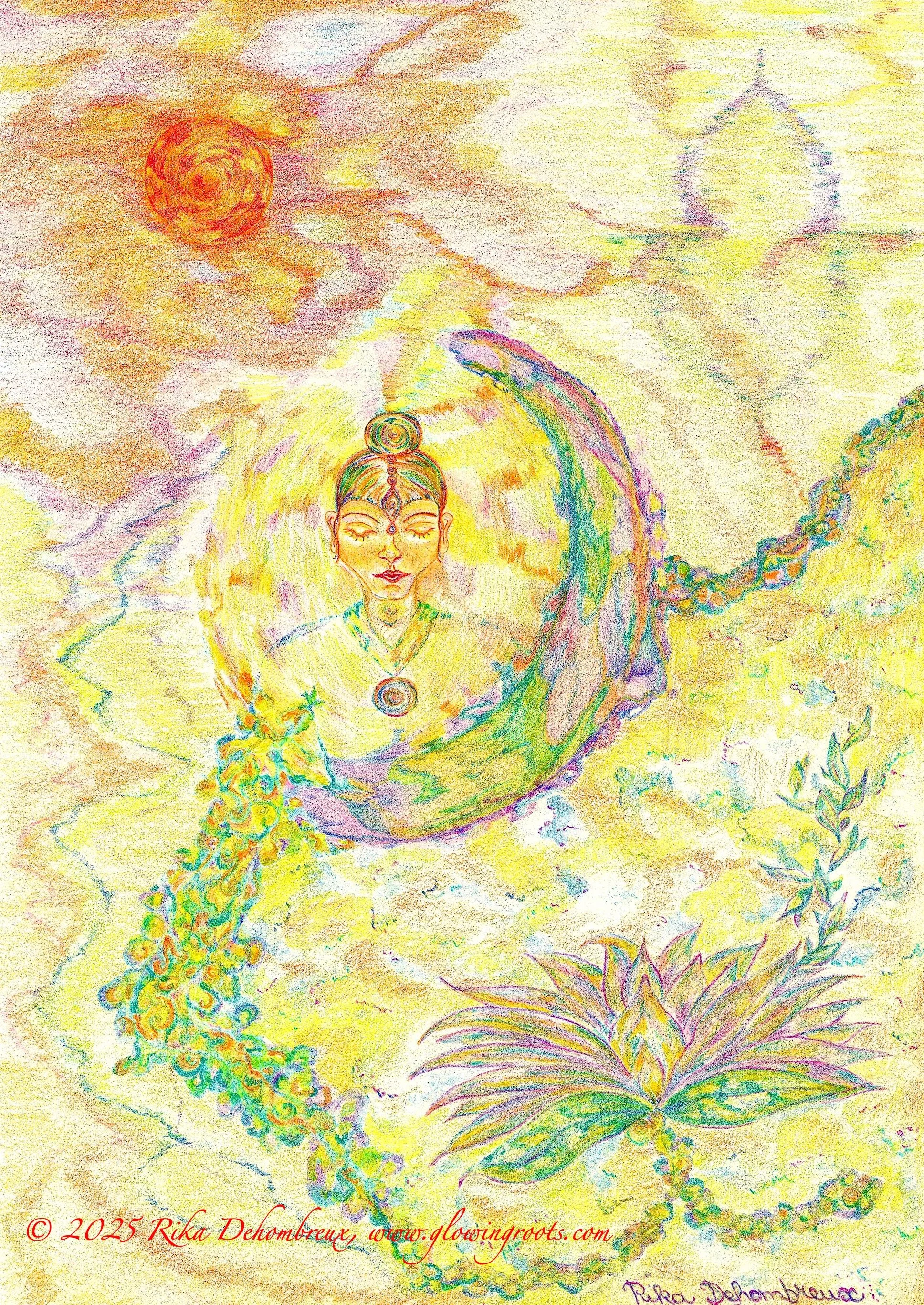
‘Day Dream’, Intuitive Drawing, Colored Pencils on Paper, by Rika Dehombreux, 2008
Symbols, Light-Beings, and an Interspiritual Practice
The imagery that appears in my work is filled with figures, symbols, and environments drawn from many traditions. I don’t approach these traditions as belief systems or doctrines, but as symbolic languages. Images allow different traditions to meet without hierarchy.
Many of the figures that appear are gentle, benevolent, and quietly present. I often refer to them as light-beings—not as fixed entities, but as symbolic companions that carry qualities such as compassion, innocence, joy, and peace.
I experience these images as messages—offered by the universe, or by a divine source—meant to bring joy, compassion, peace, hope, and comfort to the viewer.
I enjoy researching symbolic meanings, but I don’t believe images have one fixed interpretation. What an image opens for me may open something entirely different for someone else—and that openness matters to me.
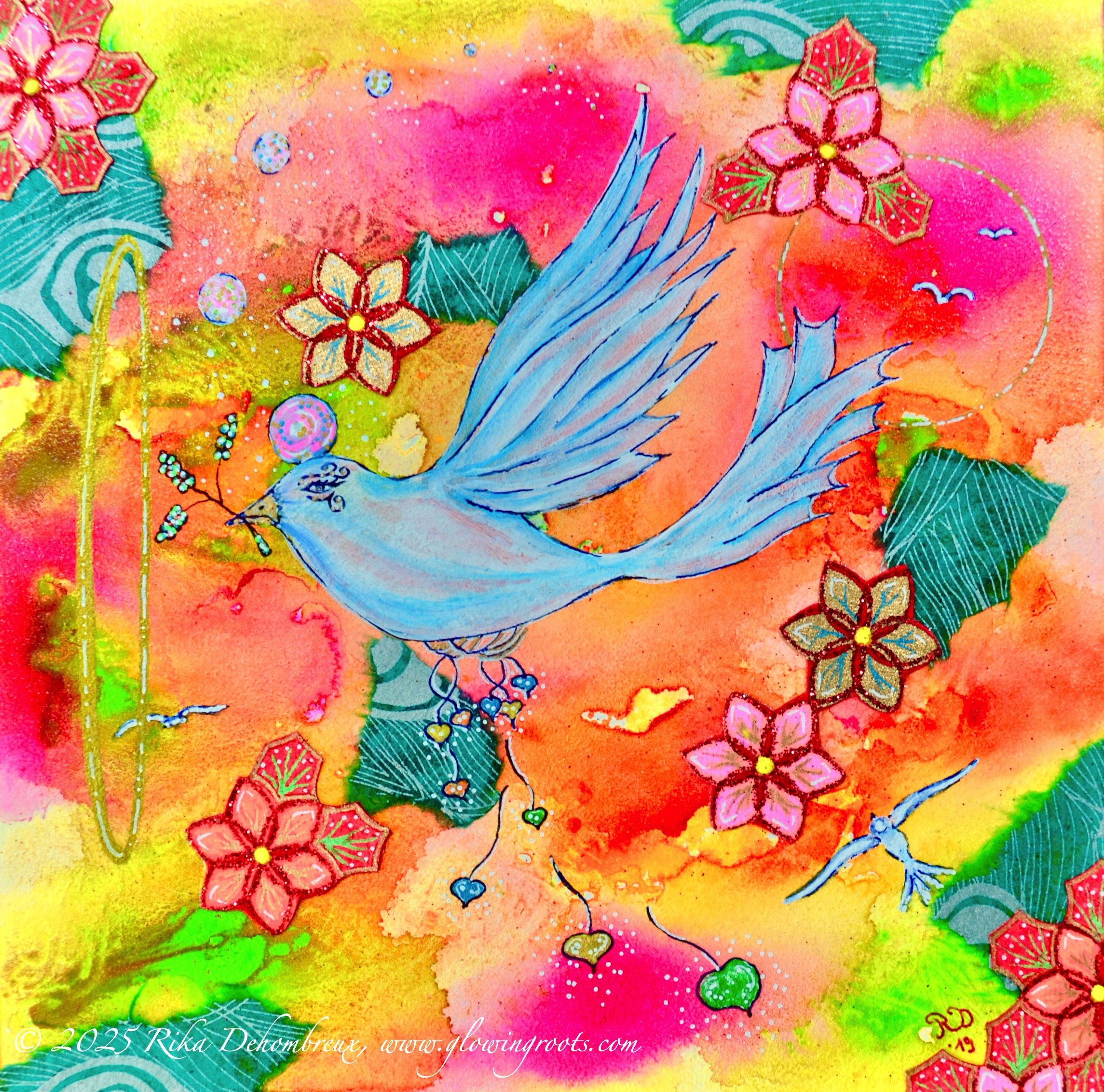
‘Bird of Faith’, Intuitive Painting, Acrylics, Pens and Collage on Panel, by Rika Dehombreux, 2019
Closing
Intuitive and visionary art, as I experience them, are not identities to define but ways of paying attention. The freedom to listen, to receive, to study, and to respond—moment by moment—is at the heart of my creative practice.
I trust both what comes toward me and what I have learned to hold it. In that meeting, the work takes form. This is where my practice lives, and where it continues to grow.
If you’d like to explore further:
– Dimensions - An Intuitive Grimoire Painting by Rika Dehombreux
– Chatting about Intuitive Art with Karimeen
Nederlands ↓↓
Is Intuïtieve Kunst Spiritueel? Verbeelding en Praktijk
Inleiding
Is intuïtieve kunst spiritueel, psychologisch, of iets anders? Het is een vraag die ik mezelf door de jaren heen vaak heb gesteld. Mijn antwoord is veranderd — niet omdat mijn werk veranderde, maar omdat mijn relatie met de betekenis ervan zich verdiept heeft. Ik voel niet langer de behoefte om één verklaring te kiezen.
Wat ik vandaag helder zie, is dat mijn creatieve praktijk zich beweegt tussen intuïtieve kunst en visionaire kunst. In veel van mijn schilderijen zijn beide aanwezig binnen één en hetzelfde werk.
Voor mij is intuïtieve kunst geen stijl of techniek, maar een manier van luisteren. Ik ervaar dit luisteren als een openheid voor iets dat groter is dan ikzelf — een stille ontvankelijkheid voor een goddelijke aanwezigheid, en voor wat zich wil tonen.
‘Beschermfee’, Intuïtief Schilderij, Aquarel, Gouache en Potlood op Papier, door Rika Dehombreux, 2009
Verbeelding, intuïtie of iets meer
Lange tijd sprak ik voorzichtig over intuïtie in kunst. Ik beschreef wat in mijn werk verscheen als verbeelding — beelden gevormd door herinnering, ervaring en het onderbewuste. Die taal hielp me gegrond en eerlijk te blijven.
Ik aarzelde om deze beelden spirituele boodschappen te noemen. Vandaag is die aarzeling zachter geworden. Wat ooit voelde als verbeelding — of misschien iets goddelijks — ervaar ik nu als relatie: een stille, voortdurende dialoog met het universum, met aanwezigheid zelf.
Het psychologische aspect blijft belangrijk. Om wat zich aandient als spirituele ervaring vorm te geven, put ik uit geheugen en kennis — opgebouwd door studie, observatie en artistiek ambacht. Intuïtieve kunst vraagt in mijn ervaring zowel psychologische verankering als spirituele openheid.
‘De Heilige Graal’, Intuïtieve Tekening, Kleurpotlood op Papier, door Rika Dehombreux, 2016
Intuïtieve kunst: luisteren vóór weten
Wanneer ik intuïtief schilder, begin ik zonder plan. Ik laat bewuste controle los en geef ruimte aan het beeld om te ontstaan. Vaak weet ik pas laat in het proces wat het kunstwerk zal worden. De hand beweegt eerst; het begrijpen volgt later.
Dit proces voelt minder als creëren en meer als ontdekken. De schilderijen ontstaan niet door beslissingen, maar door ontvankelijkheid — alsof iets onzichtbaars zich zacht onthult via kleur, lijn en vorm.
‘Keizerin van de Bloemen’, Intuïtief Schilderij, Aquarel en Gouache op Papier, door Rika Dehombreux, 2021
Visionaire kunst: wanneer beelden om aandacht vragen
Soms verschijnt er al een beeld vóór ik begin te schilderen. Het kan zich tonen als een innerlijke visie, een fragment, of een sterk gevoel van aanwezigheid. In die gevallen vraagt het creatieve proces om zorgvuldigheid: studie, referenties, aandacht en bewuste keuzes.
Niet elk visionair beeld kan volledig uit verbeelding alleen worden opgebouwd. Sommige vragen om structuur, techniek en vakmanschap. Hier wordt het belang van artistieke oefening zichtbaar — het uitbreiden van de innerlijke beeldentaal die in het geheugen leeft.
Voor mij staan visionaire kunst en intuïtieve kunst niet tegenover elkaar. Visionaire kunst is intuïtie die vraagt om halverwege ontmoet te worden — door aandacht, studie en toewijding aan vorm.
‘Dagdroom’, Intuïtieve Tekening, Kleurpotlood op Papier, door Rika Dehombreux, 2008
Symboliek, lichtwezens en een interspirituele benadering
De beelden in mijn werk zijn geïnspireerd door symbolen, figuren en landschappen uit verschillende spirituele tradities. Ik benader deze tradities niet als geloofssystemen, maar als symbolische talen. Beelden laten tradities samenkomen zonder hiërarchie.
Veel figuren die verschijnen zijn zacht en welwillend. Ik noem ze vaak lichtwezens — niet als vaste entiteiten, maar als symbolische begeleiders die kwaliteiten dragen zoals compassie, vrede, onschuld en vreugde.
Ik ervaar deze beelden als boodschappen — afkomstig van het universum of een goddelijke bron — bedoeld om rust, hoop en troost te brengen aan wie kijkt.
Hoewel ik graag symboliek onderzoek, geloof ik niet in één vaste betekenis. Wat een beeld voor mij opent, kan voor iemand anders iets heel anders openen. Die openheid is wezenlijk voor mijn manier van werken.
‘Vogel van Geloof’, Intuïtief Schilderij, Acrylverf, Pen en Collage op Paneel, door Rika Dehombreux, 2019
Afsluiting
Intuïtieve en visionaire kunst zijn voor mij geen labels, maar vormen van aandacht. Het vermogen om te luisteren, te ontvangen, te studeren en te antwoorden — moment na moment — vormt de kern van mijn artistieke praktijk.
Ik vertrouw zowel op wat zich aandient als op wat ik geleerd heb om het te dragen. In die ontmoeting krijgt het werk vorm. Daar leeft mijn praktijk — en daar blijft zij zich verdiepen.
Als je graag verder wilt ontdekken:
– Dimensies: Een Intuïtieve Grimoireschildering door Rika Dehombreux
– Praten over Intuïtieve Kunst met Karimeen
Français ↓
L’art intuitif est-il spirituel ? Imagination et pratique
Introduction
Je me suis souvent demandé si l’art intuitif était un phénomène spirituel, psychologique, ou quelque chose d’entièrement différent. C’est une question à laquelle je suis revenue de nombreuses fois au fil des années, et ma réponse a évolué — non pas parce que mon travail a changé, mais parce que ma relation à sa signification s’est approfondie. Je ne ressens plus le besoin de choisir une seule explication.
Ce que je vois clairement aujourd’hui, c’est que ma pratique créative se situe entre des modes intuitifs et visionnaires — et très souvent, les deux sont présents au sein d’une même œuvre.
Pour moi, l’art intuitif n’est ni un style ni une technique. C’est une manière d’écouter. Je ressens cette écoute comme une ouverture à quelque chose de plus vaste que moi — une réceptivité silencieuse à une présence divine et à ce qui cherche à se manifester.
‘Fée Gardien’, Peinture Intuitive, Aquarelle, Gouache et Crayon de Couleur sur Papier, < Rika Dehombreux, 2009
Imagination ou quelque chose de plus
Pendant longtemps, j’ai parlé de l’intuition avec prudence. Je disais que ce qui apparaissait dans mon travail pouvait relever de l’imagination — des images façonnées par la mémoire, l’expérience et le subconscient. Ce langage m’a aidée à rester ancrée et honnête.
J’hésitais à nommer ces apparitions comme des messages divins. Aujourd’hui, cette hésitation s’est adoucie. Ce qui ressemblait autrefois à de l’imagination — ou peut-être à quelque chose de divin — se présente désormais comme une relation : un dialogue discret et continu avec l’univers, avec la présence elle-même.
L’élément psychologique continue de jouer un rôle. Pour donner forme à ce qui se présente comme un message divin, je m’appuie sur la mémoire — façonnée par l’étude, l’observation et le savoir-faire artistique. L’art intuitif nécessite, selon mon expérience, à la fois un ancrage psychologique et une ouverture spirituelle.
‘Le Saint Graal’, Dessin Intuitif, Crayons de Couleur sur Papier, par Rika Dehombreux, 2016
L’art intuitif : écouter avant de savoir
Lorsque je travaille de manière intuitive, je commence par abandonner la planification consciente. J’apaise mon esprit et je laisse l’image émerger sans la diriger. Dans ces moments-là, je sais rarement ce que l’œuvre deviendra avant qu’elle ne soit presque achevée. La main agit d’abord ; la compréhension vient ensuite.
Ce processus de peinture intuitive ressemble moins à une construction qu’à une arrivée. Je vis ces œuvres comme des découvertes plutôt que comme des décisions — comme si quelque chose d’invisible se révélait doucement à travers la couleur, la ligne et la forme.
‘Impératrice des Fleurs’, Peinture Intuitive, Aquarelle et Gouache sur Papier, par Rika Dehombreux, 2021
L’art visionnaire : lorsque les images demandent du soin
À d’autres moments, une image apparaît intérieurement avant même que je ne commence. Elle peut se présenter sous la forme d’une vision claire, d’un fragment, ou d’un fort sentiment de présence. Lorsque cela se produit, le processus créatif demande autre chose : de l’attention, des références, de l’étude et des choix artistiques délibérés.
Certaines visions sont difficiles à façonner uniquement à partir de l’imagination. Elles demandent à être abordées avec soin, structure et compétence. C’est là que l’attention continue portée à la technique devient essentielle, en élargissant la bibliothèque intérieure d’images conservées en mémoire.
Je ne sépare pas l’art visionnaire de l’art intuitif. La vision est, pour moi, une intuition qui demande à être rencontrée à mi-chemin — par l’attention, l’étude et la dévotion à la forme.
Rêve Éveillé, Dessin Intuitif, Crayons de Couleur sur Papier, par Rika Dehombreux, 2008
Symboles, êtres de lumière et une pratique interspirituelle
Les images qui apparaissent dans mon travail sont peuplées de personnages, de symboles et d’environnements issus de nombreuses traditions. Je n’aborde pas ces traditions comme des systèmes de croyance ou des doctrines, mais comme des langages symboliques. Les images permettent à différentes traditions de se rencontrer sans hiérarchie.
Beaucoup des personnages qui apparaissent sont doux, bienveillants et discrètement présents. Je les appelle souvent des êtres de lumière — non pas comme des entités fixes, mais comme des compagnons symboliques porteurs de qualités telles que la compassion, l’innocence, la joie et la paix.
Je ressens ces images comme des messages — offerts par l’univers ou par une source divine — destinés à apporter joie, compassion, paix, espoir et réconfort à la personne qui regarde.
J’aime explorer les significations symboliques, mais je ne crois pas que les images aient une interprétation unique et fixe. Ce qu’une image ouvre en moi peut ouvrir quelque chose de tout à fait différent chez quelqu’un d’autre — et cette ouverture est importante pour moi.
‘Oiseau de la Foi’, Peinture Intuitive, Acrylique, Stylo et Collage sur Panneau, par Rika Dehombreux, 2019
Conclusion
L’art intuitif et l’art visionnaire, tels que je les vis, ne sont pas des identités à définir, mais des manières de porter attention. La liberté d’écouter, de recevoir, d’étudier et de répondre — instant après instant — est au cœur de ma pratique créative.
Je fais confiance à la fois à ce qui vient à ma rencontre et à ce que j’ai appris pour l’accueillir. Dans cette rencontre, l’œuvre prend forme. C’est là que vit ma pratique, et là où elle continue de se développer.
Si vous souhaitez aller plus loin :
– Dimensions: Une Peinture Intuitive de Grimoire par Rika Dehombreux
– Conversations autour de l‘Art Intuitif avec Karimeen